
Should Christians also keep the Mosaic Law?
A. Introduction
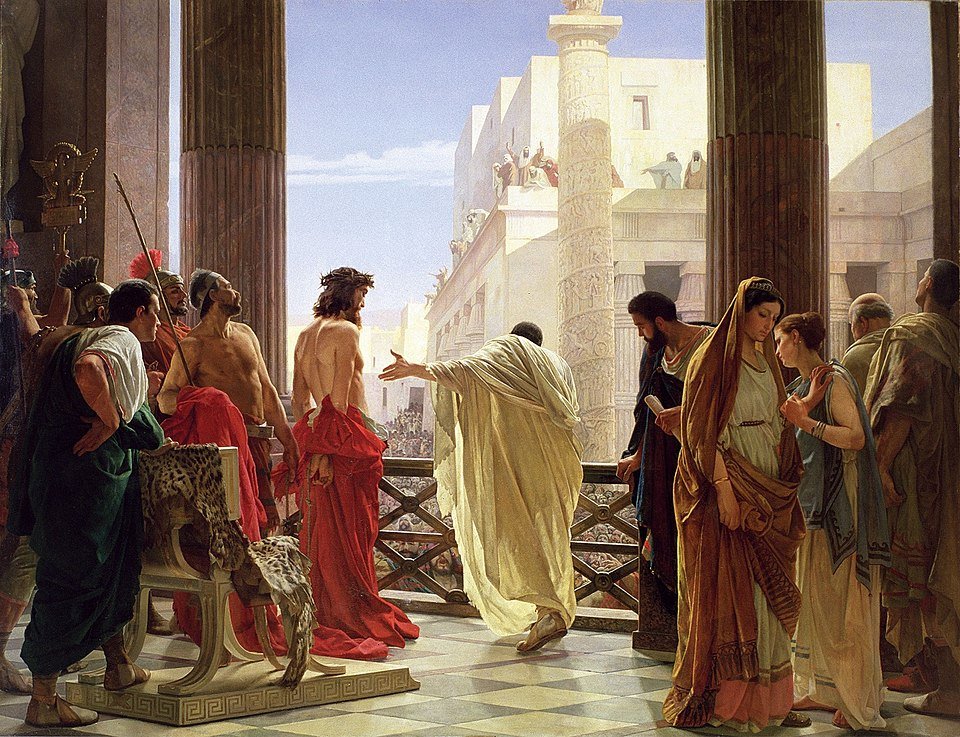
Ecce Homo by Antonio Ciseri, 1871
In the early 1980’s I was a member of the Hebrew Christian Alliance in Montreal - an organization consisting of Jewish and non-Jewish Christians. It was during that time that I first became aware of a false teaching or belief that still persists to this day among some Jewish believers and even among certain sects of non-Jewish Christians. As we shall see from what God says about this belief in the New Testament, it appears to be the most evil belief a Christian can embrace, with devastating consequences. It is a teaching that is incompatible with, and contradicts authentic Christianity as described by Christ and the New Testament in general.
The false teaching: Succinctly put, it is the belief that those who have entered the New Covenant established by Jesus Christ in his own blood, should also observe the Mosaic law in the Mt. Sinai covenant given to Moses. Over the decades since I first encountered this false belief, I have observed that the degree to which the Mosaic law should be obeyed can vary between different proponents. At a minimum, they teach that Christians should observe the feasts as described in books of Moses (rather than focus on the New Covenant realizations of those feasts), the Sabbath day of the week (Saturday) should be observed as described in the Mosaic law (rather than focus on the New Covenant Sabbath described in the book of Hebrews), along with other Mosaic laws to do with food, clothing, and so forth.
Some advice: As you continue to read, you may be tempted to look around to see who might have been deceived into embracing this false belief. Do not do that, or you may unwittingly miss your own misconceptions. Instead, ask God to search your heart. Are you, in any way, disrespecting the infinite price Christ paid for the New Covenant established in his own blood, by thinking there is also some sort of merit in also obeying the “law of Moses” and the old, Mt. Sinai covenant?
Two categories of readers: What follows in this paper will be based on a face-value approach to what the Bible states. If the reader does not profess to be a Christian but is merely curious as to what this paper says, it is hoped that they find it interesting. However, for those who both profess to be a Christian and promote the belief that we must follow the Mosaic law, that is quite a different thing. The Epistle to the Galatians speaks so directly against this false belief, that to defend it one must either distort the writings of what the Holy Spirit revealed through Paul, or dismiss the divine inspiration of Paul’s writings althogether. This problem existed in the first century, as we observe in a statement by the Apostle Peter when he wrote,
“Count the patience of our Lord as salvation, just as our beloved brother Paul also wrote to you according to the wisdom given him, as he does in all his letters when he speaks in them of these matters. There are some things in them that are hard to understand, which the ignorant and unstable twist to their own destruction, as they do the other Scriptures.” (1)
Observe that the Apostle Peter ranked the writings of Paul in with “the other scriptures” and that “the ignorant and unstable” will twist his writings “to their own destruction.”
Point: One cannot both claim to be a follower of Christ while, at the same time, distorting or dismissing what the Holy Spirit has revealed to Paul.
Exactly how evil is this false teaching?: There are a variety of mistaken theological beliefs that have negative consequences. But there are two reasons to believe that this particular false belief ranks as the most evil false teaching that Christians may encounter for two reasons:
The harshest statements the Holy Spirit has made to Christians who are falling into sin, are made to those who have put their faith in Jesus Christ for forgiveness of sins and eternal life but then, having started so well by entering the New Covenant and experienced spiritually rebirth, are misled into thinking they also need to keep the Law given at Mt. Sinai or, even worse, actively teach this false belief to other Christians. The Holy Spirit describes such people as “severed from Christ” and “accursed.” When we consider the implications of what “severed from Christ” and “accursed” might mean, there can be no greater evil for the follower of Christ to commit than, having entered the New Covenant established by the blood of Christ, to go back to also trying to follow the Mt. Sinai covenant and the laws surrounding it.
An entire book of the New Testament, Galatians, is devoted to directly addressing this false teaching. No other false teaching gets the distinction of having an entire epistle devoted to it. Furthermore, two other major books of the New Testament (Romans and Hebrews) go into an extensive, systematic theology of the New Covenant and why it is superior to the “law of Moses” and why it renders the old covenant obsolete for those who have put their faith in Christ. (Note: it is not yet obsolete for those who follow the law for, if they do, they will be judged by it and “Christ will be of no advantage to you.”(2)
What is the cause of this false belief?: Having listened at length to those who have embraced this false belief, there appears to be some common mistakes or causes for it. I will only mention some of the most significant here:
A failure to understand that the word “law” in both Greek and Hebrew, has a variety of meanings and only refers to the Law of Moses a minority of times. This is such a pervasive mistake that we will take a more detailed look at this shortly. The mistake is to assume that the word “law” in the Bible usually refers to the Mosaic law given under the Mt. Sinai covenant.
A failure to realize that those commands in the Old Covenant which were to be observed “forever” are only for those who have not been released from the Old Covenant and its laws: Once one has entered the New Covenant in Christ’s blood, one is freed from those laws (as we shall shortly see). The Hebrew word olam (translated as forever, perpetual, everlasting) appears 63 times in the first five books of the Old Testament. For example, the lamp stand with seven lamps that stood outside the veil in the tent and, later, the temple, was to be tended “from evening to morning before the LORD. It shall be a statute forever to be observed throughout their generations.” There are many other commands that were given to Moses at Mt. Sinai that were to be observed “forever” (olam). The moment one is redeemed from the Mt. Sinai covenant, one is released from all those commands contained within the covenant. All of these “forever” commands were issued within what the Holy Spirit describes in the book of Galatians as the covenant “from Mount Sinai, bearing children for slavery,” and which those under the New Covenant are commanded by God to “cast out.” If, however, one goes back to live by the Old Covenant, then one must obey all those commands “forever”. To break one is to be guilty of all, (3) and therein is the reason why those who go back to following the law are “accursed.” (4)
A failure to realize that the New Covenant is “not like” the broken Mt. Sinai covenant: The emphasis here is on “not like”. The Holy Spirit, speaking through the prophet Jeremiah, said, “Behold, the days are coming, declares the Lord, when I will make a new covenant with the house of Israel and the house of Judah, not like the covenant that I made with their fathers on the day when I took them by the hand to bring them out of the land of Egypt, my covenant that they broke, though I was their husband, declares the Lord.” (5) Since the New Covenant is “not like” the Mt. Sinai covenant, the New Covenant is not an “extension” or “outworking” of the old covenant, nor is the old, broken covenant a foundation for the New Covenant. The Old Covenant was merely a “shadow” of the reality of the New Covenant. We cannot interpret or understand the reality by looking at the shadow. It is the other way around - we understand the shadow by looking at the reality. The book of Hebrews established in every way that the New Covenant is superior and “not like” the old.
A failure to understand that the New Covenant in Christ’s blood is fully in place: The books of Romans, Hebrews, and explicitly Galatians make it crystal clear that, if we are commanded to “cast out” the Mt. Sinai covenant centred around the Mosaic law, which is described as “slavery” in Galatians then, necessarily, the New Covenant must be fully in place. There is no ‘transition’ still in effect. The New Covenant cannot be an ‘extension’ of the Old if it is so radically “not like” the Old, as expanded upon in Galatians.
A failure to grasp the utter incompatibility of observing the two covenants simultaneously: God, via the Holy Spirit, has commanded his people to “cast out” the Mt. Sinai covenant of slavery. One cannot be both slave and free, or be ‘married to both Hagar and Sarah’, but more on this shortly.
A failure to appreciate the infinite cost and value of the New Covenant: Jesus said, on the night he was betrayed, “This cup is the New Covenant in my blood.” The difference between the blood of sheep and goats, and the blood of Christ, the Lamb of God, is infinite and costly beyond measure. To think, in any way, shape, or form, that something can be added to this New Covenant, is a colossal insult to Jesus Christ. It is to say that blood of Jesus Christ is not quite sufficient; something must be added to it … “I must do my little bit.” It is hard to understand the naive arrogance of thinking one can add to what Christ has done by following the Mt. Sinai covenant laws. Even worse is to think that in any way we can somehow earn our own righteousness by trying to live by the Mosaic law - a objective that the Holy Spirit, speaking through the book of Romans, states that, “For by works of the law no human being will be justified in his sight.” (6)
A failure to understand what Jesus meant when he said he came to fulfill the law: I have observed that many of those who embrace this false belief, believe Christ came to obey the Mosaic law perfectly. This is a serious misunderstanding of what Christ came to do. We will return to this shortly.
But who can we trust?: It is imperative that one does not simply believe what people say, regarding the things of God. That includes the discussion contained in this article. Carefully study for yourself the books of Romans, Hebrews, and Galatians, as well as the whole word of God as a life-long-practice, “rightly handling the word of truth.” That means that one must accept what the Holy Spirit has revealed through the scriptures without trying to twist it so say something other than what it appears to say - a common practice among those who promote false teachings.
The only safe place to go is God’s Word. Regarding the New Covenant, the books of Romans and Hebrews provide a detailed, systematic theology on this issue, and the book of Galatians is the response of the Holy Spirit to “brothers” in Christ who have embraced this false teaching. If you realize you have fallen into this most serious of all sins a Christian can commit, I would recommend reading through the entire New Testament, taking notes in your journal, ten times for a decent start, and Romans, Hebrews, and Galatians twenty times each (and that is just a start if you want to teach others). I would recommend memorizing Galatians so that it is at your finger tips and you can contemplate it. It is only when you have an accurate understanding of the New Covenant that you will be able to understand the old, Mt. Sinai covenant. More on why this is so, later.
B. Why did Jesus say that he came to fulfill the law?
Jesus said,
“Do not think that I have come to abolish the Law or the Prophets; I have not come to abolish them but to fulfill them. For truly, I say to you, until heaven and earth pass away, not an iota, not a dot, will pass from the Law until all is accomplished.” (7)
Upon hearing this, the Scribes and Pharisees might have thought they were in excellent standing, but a couple of sentences later, Jesus said,
“I tell you, unless your righteousness exceeds that of the scribes and Pharisees, you will never enter the kingdom of heaven.” (8)
What an odd thing to say; no one was more careful about keeping the law of Moses than the Pharisees! You can keep the Mosaic law to the highest standard humanly possible and still end up lost for all eternity. Immediately following his statement, Jesus began to introduce a higher way of living than what the Mosiac law required, with his famous series of six “you have heard it said … but I say to you” statements, making it clear that there is another standard far higher than the Law. So, in what way did Jesus come to fulfill the Law?
The Law of Moses required death for anyone who broke that covenant. Jesus did not abolish that requirement but fulfilled it, so that he could then offer forgiveness, and eternal life. As the Holy Spirit has said, “the wages of sin is death, but the free gift of God is eternal life in Christ Jesus our Lord.” (9) The Old Covenant was broken, but there was a price to pay for breaking it. Christ fulfilled that demand.
The Law was a shadow of the New Covenant as well as the eternal reality behind the New Covenant. (10) Thus, Christ fulfilled the prophetic aspect of the Law which foreshadowed Christ, and the realities in the heavenlies. For example, we observe in Revelation that the old covenant lampstand with the seven lamps, was a “shadow” of the seven flames before the throne of God, which represent the seven spirits of God. The lampstand told us nothing of the reality in the heavenlies, but the reality in the heavenlies explains the lampstand. The Jewish passover was a foreshadowing of the real, ultimate passover and the eternal passover lamb who is Jesus Christ. Christ, therefore, fulfilled the prophetic “shadow” of what was to come.
It must also be noted that every single point of the Law still stands to this day for all people who reject the New Covenant or try to establish their own righteousness by keeping the Law - which no human has ever done. For the non-Jewish people, they will be judged according to the law written on their own hearts. (11) Unfortunately, for those who attempt to be righteous by keeping the law, God has said, “all who rely on works of the law are under a curse; for it is written, “Cursed be everyone who does not abide by all things written in the Book of the Law, and do them.” Now it is evident that no one is justified before God by the law.” (12) Christ came, therefore, to fulfil the demand and requirement attached to breaking the Old Covenant - by taking the place of those who had broken the law, even on just one point, and dying for our sins.
C. The Problem in the Early Church
There were certain people from the “party of the Pharisees” who were asserting that gentile believers in Antioch could not be saved unless they were circumcised. This led to what today is known as the Council of Jerusalem, as described in Acts 15. It is there that we observe this problem was bigger than merely whether physical circumcision was necessary for salvation, but certain “believers who were of the party of the Pharisees” were ordering gentile believers “to keep the law of Moses” as an ongoing way of life after putting their faith in Christ. This was not just about what it took to be saved, but how one should live after one was saved.
The council recognized this could become widespread: As they were directed by the Holy Spirit, the council knew that this was going to be a problem wherever there was a synagogue containing people of the “party of the Pharisees” promoting the same false teachings as in Antioch - and there were a lot of them. They summarized how widespread this problem could be as the reason they needed to put their decision in writing …
“For from ancient generations Moses has had in every city those who proclaim him, for he is read every Sabbath in the synagogues.”
For this reason, therefore, the decision of the Holy Spirit and the Jerusalem council was announced to gentile believers everywhere, not just to those in Antioch, as we observe later in Acts. (13)
D. The Solution to the problem
The initial response of the council in Jerusalem is elegantly short. Later, the books of Romans, Hebrews, and Galatians would give a rigorous, extensive exposition on the New Covenant and why it has replaced the Old Covenant, as well as what God has to say about those who err by trying to keep the law of Moses, as in the letter to the Galatians.
The solution is recorded as follows:
“it has seemed good to the Holy Spirit and to us to lay on you no greater burden than these requirements: that you abstain from what has been sacrificed to idols, and from blood, and from what has been strangled, and from sexual immorality. If you keep yourselves from these, you will do well.” (14)
Three observations: There are three, very important observations to make here:
Observe that this is a directive from God the Holy Spirit.
This describes how a believer should live as an ongoing practice after they had been saved - not what a person must do before they can be saved. Indeed, the Scriptures teach that salvation is by faith alone, not the result of any kind of works or good behaviour.
The phrase “no greater burden” means that there were no additional requirements associated with the “yoke” of Moses - a yoke that the Council stated that even the Jews had failed to carry. (15) To put a finer point on this, there were no additional requirements of the Mt. Sinai law that the gentile believer was required to live by. Later, we shall see it stated even more strongly in Galatians that all believers are required to “cast out” the law and covenant made at Mt. Sinai, but we shall return to this shortly.
False objection: The Father of Lies knows how destructive going back to the Mosaic law is to an authentic Christian, given that the result is to be “severed from Christ” and “accursed.” I have observed that false teachers attempt to distort the strong language in Galatians by saying that the epistle deals only with the false belief that we must follow the law in order to receive Christ, but once they receive Christ, it is then that they ought to follow the law of Moses. But the response by the Holy Spirit through the Jerusalem Council describes how the believer is to live after putting their faith in Christ, not what a non-believer must do to put their faith in Christ. It is important to recognize attempts to weave into the scriptures false beliefs. Quite simply, for the gentile believer there is “no greater burden” to also follow the Law of Moses in their ongoing spiritual life after salvation. We shall shortly see that it applies to all believers, Jew and Gentile.
A word about the Nicolaitans: Some proponents of the false belief that Christians must follow the Mosaic law will argue, on the basis of Revelation 2:6,14-15 that the “deeds of the Nicolaitans,” which Christ states that he hates, were that they taught that Christians need not follow the Mosaic law. In one particular example, the proponent of this false belief based her argument on a comment, made a few centuries earlier, by another commentator. A careful thinker ought to immediately wonder why that particular commentator is correct, especially when the fallacy of that move can be grasped the moment we observe in Revelation, that the teaching of the Nicolaitans was the same as those of Balaam, “who taught Balak to put a stumbling block before the sons of Israel, so that they might eat food sacrificed to idols and practice sexual immorality.” (16) To distort this to mean “there is no need to practice the Mosaic law” is a dishonest misrepresentation of what the passage actually says. Far worse, is to put words into the mouth of Jesus Christ that contradict the words of the Holy Spirit throughout the entire New Testament, especially those statements that Christians who follow the law of Moses are “severed from Christ” as we have already seen.
Our earliest extra-biblical description of the Nicolaitans is found in “Against Heresies” by Irenaeus, written around 180 AD. (17) In his description, he wrote,
“The Nicolaitanes are the followers of that Nicolas who was one of the seven first ordained to the diaconate by the apostles. They lead lives of unrestrained indulgence. The character of these men is very plainly pointed out in the Apocalypse of John, [when they are represented] as teaching that it is a matter of indifference to practice adultery, and to eat things sacrificed to idols. Wherefore the Word has also spoken of them thus: “But this you have, that you hate the deeds of the Nicolaitanes, which I also hate.”
Thus, Irenaeus, confirms what we observe in Revelation chapter 2. The Nicolaitans rejected the Jerusalem council’s decision to not eat food sacrificed to idols, nor commit sexual immorality. Instead they promoted the belief that it was fine to practice sexual immorality and eat food sacrificed to idols. To argue that the deeds which Christ hates are teachings that people who have entered the New Covenant need not follow the law, is a significant and dishonest misrepresentation of what is actually stated in Revelation, by Irenaeus and, most importantly, what the Holy Spirit states in the scriptures.
E. The context of the two covenants:
It is important to note that some commands are common to both the Mt. Sinai covenant and the New Covenant in Christ’s blood. Thus, they transcend the two covenants and, therefore, reflect the context within which the two covenants are given. Specifically, they are:
You shall love the Lord your God with all your heart, soul, and strength. (18)
You shall love your neighbour as yourself. (19)
You shall not commit sexual immorality
God never changes. Consequently, what was of the highest importance to God at the creation of humanity, was still of the highest importance at Mt. Sinai, and is still of the greatest importance under the New Covenant today. When Christ said of the first two above that “On these two commandments depend all the Law and the Prophets,” (20) he was making it clear that these two commands are prerequisites to both the Mosaic law, all the revelations to all the prophets, including the book of Job, and they are still in effect under the New Covenant. Today, under the New Covenant, we now have the power by the Holy Spirit to truly love God with all our being. As for the third common factor listed above, we are told why this is a universal law when the Holy Spirit, speaking through the Apostle Peter, said “abstain from the passions of the flesh, which wage war against your soul.” (21) To understand just how enormously significant this is to what it means to be created in the image of God (which occurred long before Mt. Sinai), the complete human being, created in the likeness/image/model of the triune God, is a living soul, clothed with a body, and endowed with a spirit.(22) It is “you” as a living soul, who are to exercise authority and stewardship over your body. But if, through sexual immorality, the lusts of the body subjugate you, then you eventually become a “creature of instinct,” and an “unreasoning animal” - the very opposite of what God created you to be. This was true at the fall of Adam, it was true at the time of Job long before Mt. Sinai, it was true at Mt. Sinai, and it remains true today. That is why the Holy Spirit, directing through the Jerusalem council, stated that all followers of Christ must abstain from sexual immorality.
To sum up; the context for all covenants involving mortal human beings is
The unchangeableness of God
Humans are created in the image of God, to be imitators of God, and to love God for all eternity; the soul must not be subjugated by the flesh.
Since these are the context and prerequisites for “the law and the prophets”, it does not follow that they were not true prior to Mt. Sinai. Rather, when Jesus said that the law and the prophets depend upon the two greatest commands, he designated them as the foundation for the covenant at Mt. Sinai, as well as all the prophetic revelations throughout the Old and New Testaments, as well as the New Covenant.
F. The purpose of the Mt. Sinai covenant
In his sermon on the mount, in the famous “you have heard it said … but I say to you” section, Jesus began to awaken the Jewish people to the fact that the Old Covenant, which was centred on law, was a minimum standard in comparison to what Christ required. Why did God give a minimum standard at Mt. Sinai? The reason is given in Romans 3:19-20:
“Now we know that whatever the law says it speaks to those who are under the law, so that every mouth may be stopped, and the whole world may be held accountable to God. For by works of the law no human being will be justified in his sight, since through the law comes knowledge of sin.”
The purpose was to show humanity that everyone has sinned and fallen short of God’s glory. To clarify, if you cannot even measure up to this minimum standard, you can certainly be held guilty of sin. If you have broken the law only once, you are guilty of all (3), and the “wages of sin is death.” Thus, the purpose of the law is to expose all of us as having fallen short of God’s glory. Everyone is in deep trouble - which is why the gospel and the New Covenant is the best news humanity has ever heard.
Since the law was a minimum standard, and never intended to be the measure of God-like righteousness, keeping the minimum standard of the Mt. Sinai laws could not possibly be a description of what the ultimate standard was - to be imitators of God. As the Holy Spirit has said through the Apostle Paul …
“we know that a person is not justified by works of the law but through faith in Jesus Christ, so we also have believed in Christ Jesus, in order to be justified by faith in Christ and not by works of the law, because by works of the law no one will be justified.” (23)
G. A significant mistake
A very large mistake made by some who promote this false teaching is to assume that whenever we see the world “law” in the Old and New Testaments, it refers to the “Law of Moses.” That is a big mistake.
This type of error is described by D.A. Carson as an artificial restriction of the semantic range - taking a word that has a broad range of meaning, and restricting the meaning to only one, very specific case. The full explanation of the eight different meanings for the Hebrew word torah is given in the Hebrew Aramaic Lexicon of the Old Testament (HALOT), and I have included the key section that describes the eight different meanings of the word torah, in Appendix A. Also, for the Greek word nomos, I have included the full BDAG description of the three major meanings and six nuance meanings in Appendix A as well. In general, torah refers to ‘instruction’ of various sorts of which the “law of Moses” given at Mt. Sinai is only a special case. It is a mistake to take a special case and extend it to the general application or to take a particular and extend it to a universal. Psalm 119 gives a beautiful illustration of the general meaning of torah, especially with its use of synonyms through the Psalm. If you look in Appendix A at section E4(d) for Psalm 119, you will see it defined as “Instruction”, specifically as “with reference to instruction issued by God.” In general, and within a biblical context, torah refers to any and all instruction that proceeds from the mouth of God, including the entire Bible, both Old Testament and New.
Summary point: One should never make the mistake of assuming, every time they encounter the word “law” that it refers to the “law of Moses” given at Mt. Sinai.
H. A second mistake
I discussed this at the beginning, but it is such a major mistake among those who promote the false teaching being addressed here, that it is well worth reminding the reader again. A second type of mistake is to fail to realize that there were clear and direct commands and statements given under the Old Covenant that were to be observed “forever” but, since that covenant is broken and has been replaced by a new covenant, they have been replaced by the New Covenant. For example, under the Old Covenant there were commands to do with the Sabbath and the Feasts that, provided the Old Covenant was not broken, would apply forever. Even though these commands were given to the Jewish people, those who promote the false teaching being addressing here, assume those “forever” commands also apply to non-Jewish, gentile believers. But the old covenant was broken, and the new, eternal covenant is now in place for God’s people. The book of Romans uses a marriage covenant to illustrate how obligations of the covenant end when that covenant is broken through the death of either the husband or wife, and how this applies to the New Covenant. (24) That brings us to the new covenant.
I. The New Covenant prophesied
About 700 years before Christ, God spoke through the prophet Jeremiah:
“Behold, the days are coming, declares the LORD, when I will make a new covenant with the house of Israel and the house of Judah, not like the covenant that I made with their fathers on the day when I took them by the hand to bring them out of the land of Egypt, my covenant that they broke, though I was their husband, declares the LORD.” (5)
Three observations:
This is a “new covenant”.
This new covenant will be “not like” the Mt. Sinai covenant. It follows from this that the New Covenant is not an “outworking” or “extension” of the old. It is starkly stated in clear language that it is “not like” the old. Therefore, one cannot understand the New Covenant by studying the Mt. Sinai covenant - the New Covenant is simply “not like” it. It is quite the other way around; one can only understand how the Old Covenant is a “shadow” of the new, by studying the New Covenant. The books of Romans and Hebrews are God’s explanation of the eternal, New Covenant.
It explicitly states that the Mt. Sinai covenant was broken, which explains so many descriptions of Israel in the Old Testament as an adulteress.
J. Consequences of the New Covenant:
As in a covenant of marriage, once the covenant went into place, there would be consequences, both short term and long term. The prophecy in Jeremiah goes on to list both long-term as well as immediate results. These are discussed in the Book of Hebrews chapter 8, within the context of comparing the old, Mt. Sinai covenant with the New Covenant in the blood of Jesus Christ. In Jeremiah 31, the consequences of this New Covenant are stated:
For those who have entered this New Covenant, God will put his law within them and write it on their hearts.
Those under the New Covenant will all know the Lord. The Hebrew word used in Jeremiah 31 for “know” is yodea, which is not merely knowledge of facts, but means to have first-hand, experience of a person.
Their sins will be forgiven and forgotten forever.
We shall return to the fulfillment of these consequences shortly.
K. When did New Covenant come fully into effect?
As Christ celebrated the Old Covenant passover with his disciples on the night he was betrayed, he took the cup of wine and said,
“This cup is the new covenant in my blood. Do this, as often as you drink it, in remembrance of me. For as often as you eat this bread and drink the cup, you proclaim the Lord’s death until he comes.” (25)
Observations:
There is a definite article (translated as “the”) before “new covenant.” This is not mere “a” new covenant; this is “the” new covenant as prophesied in Jeremiah 31:31.
This New Covenant is in the blood of Jesus Christ, in contrast to a passover lamb.
Drinking the cup “proclaims” the death of Jesus Christ and the shedding of the blood of the “Lamb of God” until he returns.
This to be commemorated through the bread and the wine “until he comes.” Thus, we have a description of the way the New Covenant Passover is to be celebrated, where shedding the blood of a physical lamb has no place; it is the blood of Jesus Christ now.
If the New Covenant was instituted by the shedding of the blood of Christ, then it came into effect over the next three days with his death and resurrection. The veil of the temple was torn down the middle at his death, and on the Feast of Weeks the Holy Spirit was given to all those who enter the New Covenant. Certainly, Romans, Hebrews, and Galatians make it clear, in great detail, that the New Covenant is now fully in place and we have been fully freed from the Old Covenant. As it is written …
“But now we are released from the law, having died to that which held us captive, so that we serve in the new way of the Spirit and not in the old way of the written code.” (24)
Observation: “Now we are released from the law,” and “we serve in the new way of the Spirit and not in the old way of the written code.” We can infer from this that the law of God now dwells within us in the person of God the Holy Spirit. Given what God has said here and in great detail in Romans, Hebrews, and Galatians, the New Covenant came into full effect when Christ died for our sins and “was raised on the third day in accordance with the Scriptures.”
L. The meaning of “New Testament”
The phrase “new covenant” in Jeremiah 31:31 in Hebrew is brit hadasha which, in English, means “new covenant.” So if one purchases a New Testament in Hebrew, you will observe it is called, in Hebrew, ha brit he hadasha which literally translates as “the covenant the new”.
Most people today likely think of “testament” in terms of some sort of testimony, but the title “New Testament” first came into use around AD 1384 when the Wycliffe Bible translation emerged. At that time, “testament” meant “covenant or solemn divine arrangement.” So, the New Testament is more accurately called the “New Covenant” as it is in Hebrew.
***********************Note: I have only done the final edits and references to this point. But I must leave shortly for a one-day trip and, in case something unfortunate happens, at least this semi-final copy will be available. I will complete the final edits and remaining references by next Tuesday if I am able. I wll also make a downloadable pdf available once I’m finished. ******************************
M. Fulfillment of the Consequences of the New Covenant
According to the prophecy of the New Covenant in Jeremiah, there would be three consequences of this new covenant. The New Testament describes their fulfillment.
For those who have entered this New Covenant, God will put his law within them and write it on their hearts. One of the passages that describes the fulfillment of this consequence has been mentioned already, but here it is again, ““But now we are released from the law, having died to that which held us captive, so that we serve in the new way of the Spirit and not in the old way of the written code.” Note that the “written code” has been replaced by the guidance of the Holy Spirit within the true Christian. Jesus said, “When the Spirit of truth comes, he will guide you into all the truth.”(26) This does not mean that moral laws given at Mt. Sinai are arbitrary - rather the New Covenant has an even higher standard of morality (as we see in the famous “you have heard it said … but I say to you” series. But now the power to live a life that is pleasing to God now comes from the Holy Spirit who dwells within us, as it is written, “walk by the Spirit, and you will not gratify the desires of the flesh.”(27)
Those under the New Covenant will all know the Lord, where the Hebrew word “know” means to have first-hand experience and knowledge of God. Under the Old Covenant, the veil in the temple separated the presence of God from those who followed him. Under the New Covenant, the veil was supernaturally torn down the middle, and God himself dwells within each of his beloved in the person of the Holy Spirit; Christ abides in us and we in him. We now experience directly the presence of God within us.
There is, as well, another result or consequence of the New Covenant that may apply to the ethnic Jewish people in the last days. According to Zechariah two thirds will be destroyed in the end, but one third will survive and God states, “I will put this third into the fire, and refine them as one refines silver, and test them as gold is tested. They will call upon my name, and I will answer them. I will say, ‘They are my people’; and they will say, ‘The LORD is my God.’”(28) There are many ethnic Jews who have already entered the New Covenant, but this prophecy appears to be referring to the Jews as an entire ethnic group or, as God puts it in the New Covenant, they will be “grafted in” again. As the Holy Spirit has said to the non-Jewish people, “if you were cut from what is by nature a wild olive tree, and grafted, contrary to nature, into a cultivated olive tree, how much more will these, the natural branches, be grafted back into their own olive tree.”(29) (Note: As Romans, Hebrews, and Galatians make very clear, the New Covenant is already in full effect, but the consequences of that covenant continue to unfold now and into the future, as we see here.) One should not make the mistake of thinking that, since the consequences are still unfolding that, therefore, the New Covenant is not yet fully in place. The reproof and rebuke in Galatians clearly exposes that as a false belief, not to mention the more extensive discussions in Romans and Hebrews. Do not confuse the New Covenant becoming fully emplimented upon the resurrection of Christ, with the unfolding results of that covenant.For those who have entered the New Covenant, their sins will be forgiven and forgotten forever. Under the Mt. Sinai covenant, it was “impossible for the blood of bulls and goats to take away sins.” and “every priest stands daily at his service, offering repeatedly the same sacrifices, which can never take away sins.” But “But when Christ had offered for all time a single sacrifice for sins, he sat down at the right hand of God … For by a single offering he has perfected for all time those who are being sanctified.”(30)
N. The blessings and the curses of the two covenants
Old covenant:
Biblical scholars have observed that the book of Deuteronomy is beautifully structured according to ancient near-east treaties or covenants between a king and those he rules over. Those sections are as follows:
Preamble: identifies the covenant mediator, the context of the covenant, and who is entering the covenant (Deut. 1:1-5)
Historical background to the covenant (Deut 1:6-4:43)
General covenant rules (Deut 4:44-11:32)
Specific covenant rules (Deut 12:1-26:19
Covenant ratification procedure (Deut 27:1-26)
The blessings (15 verses) and curses (53 verses) for honouring or breaking the covenant (Deut. 28:1-68)
Formal renewal of the covenant (Deut 29:1-30:20)
Preservation of the covenant (Deut 31:1-34:12)
Deuteronomy 28 provides us with a very clear itemization of the blessings and curses associated with the Mt. Sinai covenant.
Observation: As you read down through the blessings and curses, you will note that all of them are physical, material blessings and curses that applied to their mortal lives in this material world. Disease-free, ruling over, abundant crops, rains in their season, financial wealth vs. diseases, subjugation, famine, drought, and poverty.
A large mistake: A most unfortunate mistake many believers make today is to read all the blessings and promises stated under the law, and assume they still apply today - forgetting that those blessings and curses were made under the old covenant. Those Mt. Sinai blessings and curses have been replaced by something very different under the new covenant. Particularly guilty are those who preach a ‘prosperity gospel’, which has led to the ruin of faith for many.
New Covenant:
Under the New Covenant, there is a remarkable difference from the blessings and curses under the old. First, there is no guarantee of health, wealth, and prosperity. Hebrews 11 makes it very clear that our reward lies in eternity. In this world, we will be persecuted. We observe in Christ’s parable of the rich man and Lazarus that it is the godless man who has all the material wealth and righteous Lazarus has nothing but his faith in God. We are also told by Christ to not pursue material wealth that can be stolen or corrupted, but to lay up treasure in heaven. We observe that “God has chosen those who are poor in the world to be rich in faith and heirs of the kingdom.” We are told that we will be “hated by all” on account of the name of Jesus Christ and that, in the last days, the Beast will be “allowed to make war on the saints and to conquer them,” just prior to the return of our King. We are told that God will “discipline” those he loves, and refine them as gold is refined in fire.
Jesus summarizes it nicely for those who enter the New Covenant, “In the world you will have tribulation. But take heart; I have overcome the world.” The New Covenant blessings are eternal, rather than material. The Holy Spirit says through the Apostle Paul, that our Heavenly Father “has blessed us in Christ with every spiritual blessing in the heavenly places.”
Mistaken belief: Those who have been deceived often believe that since they are experiencing physical and material wealth and prosperity, they must be on the right track. But what we see in the New Covenant, is that this is a deception by the “father of lies”. Satan is happy to reward his followers with plenty of wealth up to including the entire world, as we see in the temptation of Jesus.
As for the curses, there is really only one under the New Covenant, and it is eternal as well. For example, in Hebrews 10 we have a comparison between capital punishment under the Mt. Sinai covenant and an infinitely worse punishment under the New Covenant. Before we read it, keep in mind that, as we shall shortly see in Galatians, if a person has received Jesus Christ and then begins to also observe the Mosaic law, they are “severed from Christ” and “accursed”. Therefore, to deliberately go back to observing the Mosaic law is to deliberately practice the worst sin a believer can commit - given the magnitude of the consequences. As an additional point, in the passage below, note that the phrase, “has profaned the blood of the covenant by which he was sanctified” is in the past tense, i.e., the past tense entails that “he was sanctified” by the blood of the covenant, so he is speaking to believers here. It entails that this is something that can be done by one who has already been purified by the blood of Jesus Christ. It states,
“if we go on sinning deliberately after receiving the knowledge of the truth, there no longer remains a sacrifice for sins, but a fearful expectation of judgment, and a fury of fire that will consume the adversaries. Anyone who has set aside the law of Moses dies without mercy on the evidence of two or three witnesses. How much worse punishment, do you think, will be deserved by the one who has trampled underfoot the Son of God, and has profaned the blood of the covenant by which he was sanctified, and has outraged the Spirit of grace? For we know him who said, “Vengeance is mine; I will repay.” And again, “The Lord will judge his people.” It is a fearful thing to fall into the hands of the living God.”(31)
Note that the penalty under the New Covenant for continuing to follow the law and thereby attempting to earn right standing before God is “much worse” than mere stoning to death under the Old Covenant. This may centre around the fact that the New Covenant is in Christ’s blood. To go back to also observing the Mosaic law as an attempt to make yourself righteous is an insult to the blood of Christ upon which the New Covenant is established.
O. God’s message to believers who also practice the Mt. Sinai laws
It is especially notable that the Holy Spirit, in inspiring the Holy Scriptures, has devoted the entire book of Galatians to directly address the false belief that a person who has entered the New Covenant should also practice some of the laws of Moses. We can, therefore, read in detail what God has to say about that false belief, and about those who promote it.
Observation: The letter to the Galatians is written to people who are already Christians in the churches of Galatia. The Holy Spirit, speaking through Paul, refers to them as “brothers,” a term used for believers, and distinguished from “false brothers.”(32) Some false teachers try to twist this to claim that Galatians is being written to those who want to clarify what it takes to enter the New Covenant. But it is consistently clear through out the letter that the Holy Spirit is speaking to “brethren” - those who have already put their faith in Christ, and he is telling them how they should and should not live as people who have been “redeemed” from living under the law, as we shall see below.
In this very short article, it is not possible to go through the entire book, verse by verse, but having established that the message is being delivered to Christians, Galatians makes it very clear how Christians ought not to live, and what “false brethren” ought not to teach. Specifically, those who are in Christ are to “cast out” the old covenant, as we shall now see.
Chapters 4 and 5 get to the heart of the matter in what the Holy Spirit has to say through Paul, to the Galatians. This section opens with,
“When the fullness of time had come, God sent forth his Son, born of woman, born under the law, to redeem those who were under the law, so that we might receive adoption as sons. And because you are sons, God has sent the Spirit of his Son into our hearts, crying, “Abba! Father!” So you are no longer a slave, but a son, and if a son, then an heir through God.”(33)
Observations:
Christ was born “under the law” so that he could “redeem those who were under the law.”
Those who are redeemed from under the law, are no longer slaves, but sons.
Note the meaning of redemption. Under the law, a slave could be redeemed. In this case, the person is being redeemed from the kind of slavery that comes from being under the law, and the consequences of failing to keep the entire law without failing on a single point.(3)
God then continues on in Chapter 4 to drive home exactly what he commands those who are under the New Covenant with regard to observing the law and the Mt. Sinai covenant. He uses an allegory to make his point.
Allegory: A story, event, or description in which the people, events, or details represent a spiritual truth. Many parables that Jesus told are simple allegories to help the listener understand a God-established truth. Some allegories may use a fictional story, but not this one. It uses true, historical events to drive home true spiritual facts.
The allegory begins as follows …
“Tell me, you who desire to be under the law, do you not listen to the law? For it is written that Abraham had two sons, one by a slave woman and one by a free woman. But the son of the slave was born according to the flesh, while the son of the free woman was born through promise. Now this may be interpreted allegorically: these women are two covenants. One is from Mount Sinai, bearing children for slavery; she is Hagar. Now Hagar is Mount Sinai in Arabia; she corresponds to the present Jerusalem, for she is in slavery with her children. But the Jerusalem above is free, and she is our mother.”(34)
Observations:
The Holy Spirit is speaking to those brethren who desire to keep some or all of the law, specifically, the law associated with the covenant given at Mt. Sinai.
The law given at Mt. Sinai produces “children for slavery” and Jerusalem as the centre for the temple, and the Mt. Sinai covenant was an example of the kind of slavery that comes from having to observe the Mt. Sinai laws.
The “slave woman” represents the law and the covenant established at Mt. Sinai, which was centred around the law.
God’s command to all believers who have entered the New Covenant, represented by Sarah, is as follows,
“Cast out the slave woman and her son, for the son of the slave woman shall not inherit with the son of the free woman.”
This could not be stated more clearly and bluntly … “cast out” the law-centred, Mt. Sinai covenant. Cast it out.
Observations:
Once a person has entered into the New Covenant in the blood of Jesus Christ, they are commanded by God to “cast out” the law-centred, Mt. Sinai covenant. We are not merely redeemed from under the law, we are commanded to have nothing more to do with keeping it. As we shall shortly see, there is an infinitely higher law instead.
Those who choose slavery under the law “shall not inherit” with those who have entered the New Covenant. This ought to be a very sobering statement for anyone redeemed by the blood of Christ, but who believes we should also follow the law of Moses.
Point: If you have been redeemed through the blood of Jesus Christ, God commands you to “cast out” the Mt. Sinai covenant which is centred around the law. The Old Covenant and the New Covenant do not mix; they are not compatible. They are radically different. One cannot be both married to Hagar as well as to Sarah. You must choose one or the other. To choose both is to choose Hagar and, as we see below, to be “severed from Christ.”
“For freedom Christ has set us free; stand firm therefore, and do not submit again to a yoke of slavery. Look: I, Paul, say to you that if you accept circumcision, Christ will be of no advantage to you. I testify again to every man who accepts circumcision that he is obligated to keep the whole law. You are severed from Christ, you who would be justified by the law; you have fallen away from grace.”(35)
Observations:
To go back to obeying the law is to “submit again to a yoke of slavery” of being required to keep the whole law, without failing on even one point.
Those who feel they should also obey the law of Moses are “severed from Christ,” and “fallen away from grace.” “Christ will be of no advantage to you.” You simply cannot be part of both covenants; you must cast out the Mt. Sinai covenant.
You have been called and redeemed from slavery under the law, to freedom in Christ.
All this points to one of the names of our redeemer, as prophesied in Jeremiah - “the Lord is our righteousness” (YHWH tsidkeynu). The kind of righteousness the Kingdom of God requires is flawless perfection. That can only come as a gift through the blood of Christ, not by works of the law under which no flesh will be justified.
P. What do we do with the law?
If one asks fellow believers in Christ, “Should we keep the ten commandments?” the answer is usually “Of course!” The correct answer, however, should be more like, “No and Yes.” To clarify, in the sermon on the mount, Christ points out that some of those commands fall short of what God actually requires. The ten commandments were as follows:
You shall have no other gods before me.
You shall not make any images and bow down and worship them
You shall not take the name of the Lord in vain.
Remember the sabbath day to keep it holy.
Honour your father and mother.
You shall not murder.
You shall not commit adultery.
You shall not steal.
You shall not bear false witness.
You shall not covet what belongs to others.
The first three commands have to do with our relationship with God. The fourth command has to do with resting from our works. The last five commands have to do with our relationships with others.
The first category focuses more on what we must not do with respect to God. Those first three can be replaced by another command, also given at Mt. Sinai but transcends both covenants and given the greatest and highest priority under the New Covenant - “you shall love the Lord your God with all your heart and with all your soul and with all your mind and with all your strength”.
In the sermon on the mount, Christ begins to introduce, in his “you have heard it said - but I say to you” series within the sermon, the awareness that the ten commandments were actually a minimal standard. For example, under the Old Covenant, you could not physically sleep with someone you were not married to but the moral reality is that you cannot even lust after a woman. Under the law of Moses, you must not physically murder someone, but the moral reality is that you cannot even call someone a fool, nor can you hate someone. Later, we see that he who hates is brother is a murderer.
Point: Rather than look to the ten commandments as the standard, if you live by the two greatest laws as affirmed by Christ, you will automatically exceed the much lower standard spoken of in the ten commandments, when it comes to your relationships with God and others.
The sabbath command is particularly interesting. It is the only command that, when his disciples picked and ate grain on the sabbath, and the Pharisees pointed out it was a violation of the law of Moses, Jesus did not contest that it was not lawful, but defended his disciples with the announcement that he is “Lord of the Sabbath.” What justified him in doing this is that he was about to introduce the real, eternal sabbath. The Mt. Sinai sabbath day was only a “shadow” of the real, eternal rest from our works that God calls us to.
The New Covenant Sabbath: Hebrews, in its comparison of the New Covenant with the Mt. Sinai covenant, presents a very different kind of Sabbath rest, one that is continual and eternal, and centres around freedom from the law. It is a permanent rest from “works” which primarily include living by rules and regulations as stipulated in the law, particularly (or specifically) in achieving a right standing before God. Now, Christ is the one who, according to the prophecy “is our righteousness.”
“if Joshua had given them rest, God would not have spoken of another day later on. So then, there remains a Sabbath rest for the people of God, for whoever has entered God’s rest has also rested from his works as God did from his. Let us therefore strive to enter that rest, so that no one may fall by the same sort of disobedience.”
Observations:
This is a permanent rest from attempting to achieve righteousness by “works.” Salvation is a “gift of God, not a result of works, lest anyone should boast.”
We must “strive” to enter that rest. The Greek word used here means “to be especially conscientious in discharging an obligation.” Our human tendency is to earn our way so the striving here is to resist falling back into this habit.
Point: In the Old Covenant sabbath day, one rested from physical labours on the seventh day each week. In the New Covenant Sabbath we are to enter a permanent, continual rest from slavery under the law.
Even though we are commanded to “cast out” the law-centred Mt. Sinai covenant, we are also told that it was a “shadow” of the true spiritual realities. We do not understand the reality of anything by studying the shadow. Instead, we understand the shadow by studying the reality that casts that shadow. The symbol or prophetic shadow of the sabbath in the old covenant, now makes sense in light of the true, eternal sabbath. The sabbath year in particular foreshadowed God’s promised provision when in trusting Him. We can also see why the true sabbath is eternal.
Unfortunately, many people fail to comprehend the true New Covenant Sabbath when they get distracted into thinking they are keeping the sabbath by not doing work on Saturday (or Sunday). The old covenant sabbath rest from physical work was a foreshadowing of the true sabbath where salvation is not a result of works, but a gift of God. Keeping the Mt. Sinai law is actually a violation of the New Covenant sabbath. That being said, the sabbath day was made for man, not man for the sabbath, so there is great benefit in a day of resting from our physical work, so long as we realize that we are not actually earning any merit with God for doing so; it is the real, New Covenant sabbath that must be kept holy, rather than profaning it with obeying the works of the law from which we have been redeemed.
The Mt. Sinai feasts vs the New Covenant fulfillments: The three feasts, including Passover, the feast of first fruits at the beginning of the harvest, and the feast of ingathering when the harvest was completed, all have very obvious New Covenant realities. The shedding of the blood of Christ at Passover was no coincidence, nor was the first 3000 converts to faith in Christ at the feast of weeks/feast of harvest of first fruits a coincidence. It marked the beginning of the harvest of souls that Christ spoke of. The harvest is not yet completed, so the New Covenant feast of ingathering is still to come when the Son of Man swings his sickle over the earth and the earth is reaped.(Revelation 14:14-16) It is worth noting that the Feast of Booths/Ingathering is the only feast that all the nations will be required to come to Jerusalem to celebrate after Christ has returned. That will celebrate the completion of God’s harvest of human souls for the Kingdom of God.
Q. Personal application
Do not look around at others to see who might be falling into the sin of re-introducing the law of Moses into the New Covenant. It is far better to examine yourself and ask yourself these questions before the Lord:
Do I truly realize the magnitude of the sufficiency of the blood of Jesus Christ and the New Covenant in his blood and the freedom from the law that comes with it?
Is there anything I need to repent of?
R. Final summary
It appears that the most devastating sin a Christian can commit is, having entered the New Covenant in the blood of Jesus Christ, to then go back to observing the “law of Moses” given at Mt. Sinai. Why? It is the only sin that an entire book of the Bible is devoted to directly confronting, and the consequences of that sin is that the believer is “severed from Christ” and “accursed,” with the awful implications that conveys. This false belief comes from a failure to grasp the enormous magnitude of what Christ has done for us through the New Covenant in his blood and how beautifully and totally complete his salvation through the New Covenant is, including a redemption from the law. The solution, when faced with the false teaching addressed in this article, is to truly understand what God has said in the books of Romans, Hebrews, and Galatians, and to be diligent to fully enter the New Covenant sabbath rest from our works. The blood of Jesus Christ is holy beyond our comprehension; it is an insult to the blood of Jesus Christ to go back to following the law of Moses given at Mt. Sinai. Jesus’s prayer in Gethsemane to have “this cup” pass “if it be possible” shows that there is no possible way to earn our way, or add to what Christ has done, by also keeping the law given at Mt. Sinai.
References:
2 Peter 3:15-16.
Galatians 5:2.
James 2:10.
Galatians 3:10.
Jeremiah 31:31,32.
Romans 3:20.
Matthew 5:17.
Matthew 5:20.
Romans 6:23.
See Colossians 2:17, Hebrews 8:5 and 10:1.
Romans 2:12-16.
Galatians 3:10-14.
Acts 21:25.
Acts 15:28-29
Acts 15:10 and Luke 11:46.
Revelation 2:14-15.
Irenaeus, Against Heresies 1.26.3.
Deuteronomy 6:5 and Matthew 22:37.
Leviticus 19:18.
Matthew 22:40.
1 Peter 2:11.
1 Thessalonians 5:23.
Galatians 2:16.
Romans 7:1-6.
1 Corinthians 11:25-26.
John 16:13.
Galatians 5:16.
Zechariah 13:8-9.
Romans 11:24.
Hebrews 10:12-14.
Hebrews 10:26-31.
Galatians 2:4.
Galatians 4:4-7.
Galatians 4:21-26.
Galatians 5:1-4.
Appendix A
Part 1: The meaning of the Hebrew word torah, translated as “law” in the Old Testament
Ludwig Koehler et al., The Hebrew and Aramaic Lexicon of the Old Testament (Leiden: E.J. Brill, 1994–2000), 1711–1712.
This contains only an abbreviated discussion of torah, containing the key section (E) that describes the eight different meanings of the word torah.
תּוֹרָה: E. the meaning of the sbst. and its usage.
—1. direction, instruction (later law, see Sept. νόμος and MHeb. (see above B).
—I. Outside specifically theological con-texts, on which see KBL; Liedke loc. cit. 195f; THAT 2: 1035; and also Zorell Lexicon 893f; König Wb. 539: תּוֹרָה as instruction or teaching by the wise (חָכָם) Pr 13:14 and probably also 3:1 6:23 7:2; the voice of my teachers קוֹל מוֹרָֽי Pr 5:13; instruction from the father of a family Pr 4:1f, cf. 4:4, 11; from the mother Pr 1:8 6:20; from the woman of the house 31:26; in Pr 28:9 the originator of the teaching is not identified in particular, and teaching from an instructor is not excluded, see Plöger BK 17: 334; but NRSV: when one will not listen to the law; REB: if anyone turns a deaf ear to God’s law.
—II. תּוֹרָה in a theological context: —1. administered by the priest, on which see especially J. Begrich Die priesterliche Tora (BZAW 66; 1936) 63-88 = ThB 21; 1964 232-260); THAT 2: 1035 (with bibliography); cf. also de Vaux Inst. 1: 221ff = Lebensord. 1: 230ff: Dt 33:10 Jr 18:18 Ezk 7:26 22:26 Hos 4:6 Zeph 3:4 Hg 2:11 Mal 2:6-9 (vs.7 בִּקֵּשׁ תֹּ׳); cf. Hos 8:1, 12 (rd. תֹּרֹתָֽי), Jr 2:8 8:8 on which see THAT 2: 1035.
—2. instruction, decision from different sources, or rather from different authorities: a) from Zion Is 2:3 Mi 4:2.
—b) from the prophets Is 1:10 (on which see Wildberger BK 10: 36, cf. also under 4b), 5:24 8:16, 20 parallel with תְּעוּדָה (on vs.16 cf. TOB note), 30:9 Zech 7:12.
—c) from the servant of God Is 42:4, cf. 42:21 (gloss), 51:4, see Westermann Jes. (ATD 19) 190ff.
—d) from a judicial or priestly official Dt 17:11, see THAT 2: 1035f.
—3. sg. established, particular instruction, rule (for bibliography see THAT 2: 1037): תּוֹרַת הָעוֹלָה Lv 6:2; תּוֹ׳ מִנְחָה 6:7; תּוֹ׳ חַטָּאת 6:18; so תּוֹרַת with אָשָׁם 7:1; זֶבַח הַשְּׁלָמִים 11:7; הַבְּהֵמָה וְהָעוֹף 11:46; הַיֹּלֶדֶת 12:7; הַמְּצֹרָֽע 14:2; נֶגַע צָרָֽעַת תּוֹרַת אֲשֶׁר בּוֹ 14:32 (cf. Gesenius-Kautzsch Gramm. §130, 1c); תּוֹרַת הַצָּרָֽעַת 14:57; תּוֹ׳ הַזָּב 15:32; תֹּ׳ הַקְּנָאֹת Nu 5:29 (→ קִנְאָה 3); הַנָּזִיר 6:13, 21; תֹּ׳ הַבַּיִת the rule for the temple-precincts Ezk 43:12, see Zimmerli Ez. 1070, 1087; cf. מְנָאוֹת הַתּוֹרָה (pl. from → *מְנָת) the prescribed contributions Neh 12:44.
—4. תּוֹרָה instruction (as a synopsis or embodiment of instructions): a) תּוֹרַת יהוה Ex 13:9 2K 10:31 Jr 8:8, cf. Hobbs ZAW 86 (1974) 28; Am 2:4 Ps 1:2 19:8 119:1, on which cf. Kraus BK 15/3: 39ff, 202-204; THAT 2: 1039f; Ezr 7:10 1C 16:40 22:12 2C 12:1 17:9 31:3f 35:26.
—b) הָאֱלֹהִים Neh 10:29f; תֹּ׳ אֱלֹהֶיךָ Hos 4:6 (see above II 1); אֱלֹהָיו Ps 37:31, תֹּ׳ אֱלֹהֵינוּ Is 1:10 (see above II 2b).
—cα) תֹּ׳ הָאֱלֹהִים אֲשֶׁר נִתְּנָה בְיַד מֹשִׁה Neh 10:30; תּוֹרַת מֹשֶׁה 1K 2:3 2K 23:25 Mal 3:22 Da 9:13 Ezr 3:2 7:6 2C 23:18 30:16; β) סֵפֶר תּוֹרַת־יהוה בְּיַד־מֹשֶׁה 2C 34:14 > סֵפֶר תּוֹרַת מֹשֶׁה Jos 8:31 23:6 2K 14:6 Neh 8:8; בַּתּוֹרָה בְסֵפֶר מֹשֶׁה 2C 25:4; γ) סֵפֶר הַתּוֹרָה 2K 22:8, 11, on which cf. G.W. Ahlström Royal Administration and National Religion in Ancient Palestine (Leiden, 1984) 73 (with bibliography); THAT 2: 1041; סֵפֶר הַתּוֹרָה הַזֶּה Dt 28:61 (textual emendation), 29:20 30:10 31:26, cf. Barnabas Lindars Torah in Deuteronomy in D. Winton Thomas Fschr., 117-136; G. Braulik Die Ausdrücke für “Gesetz” im Buch Deuteronomium (Biblica 51; 1970) 39-66; cf. THAT 2: 1040; also von Rad Theol. 16 213.
—d) תּוֹרָה with sf. with reference to instruction issued by God: תּוֹרָתִי Jr 31:33, cf. Is 51:7 and elsewhere; תּוֹרָֽתְכָ/תֶֽךָ on which see especially Ps 119:34, 44, 53, 55 and elsewhere; תּוֹרָתוֹ Is 42:24, see Friedrich Reiterer Gerechtigkeit als Heil (Graz, 1976) 60-62: תּוֹרָה in Is 40-55; Jr 44:23, Ps 1:2 78:10; pl. תּוֹרֹ(וֹ)תַי/תָֽ׳ Gn 26:5 Ex 16:28; תֹּ(וֹ)רֹתָיו Ex 18:16 Ezk 43:11 44:5 (Q), Ps 105:45 Da 9:10.
—5. a) תּוֹרָה together with synonyms: חֻקּוֹת, מִצְוֹת, מִשְׁמֶרֶת, תּוֹרֹת Gn 26:5; מִצְוֹתַי וְתּוֹרֹתַי Ex 16:28; חֻקֵּי הָאֱלֹהִים וְתוֹרֹתָיו Ex 18:16; הַחֻקִּים וְהַתּוֹרֹת Ex 18:20; חֻקָּיו וְתוֹרֹתָיו Ps 105:45; הַתּוֹרָה וְהַמִּצְוָה Ex 24:12; הַחֻקִּים וְהַמִּשְׁפָּטִים וְהַתּוֹרֹת Lv 26:46; בְּתוֹרָתוֹ וּבְחֻקֹּתָיו Jr 44:23; מִצְווֹת וְחֻקִּים וְתוֹרָה Neh 9:14; חֻקִּים, מִצְוָה, תּוֹרָה, מִשְׁפָּטִים 2C 19:10, etc; see also THAT 2: 1039f.
—b) תּוֹרָה together with חָזוֹן and עֵצָה Ezk 7:26 (see above II 1); תּוֹרָה parallel with עֵדוּת Ps 78:5.
—6. תּוֹרָה which is inculcated, given, imparted: הִזְהִיר Ex 18:20, on which see Noth Ex. (ATD 5) 116: for the translation of the vb. as inculcate, see also Macholz ZAW 84 (1972) 32830; נָתַן בֵּין Lv 26:46, on which see Bruno Baentsch Exodus-Leviticus-Numeri (GHK 1/2; 1903) 437: the commandments stand between Yahweh and the people as a covenant duty; cf. also Noth Lev. (ATD 6) 171; עָשָׂה לְ to turn to, carry out Nu 5:30; with צִוָּה Nu 19:2 31:21 Dt 33:4 Jos 22:5 2K 17:13, 34 21:8 Neh 8:1 9:14 1C 16:40; בֵּאֵר to make clear, comment upon Dt 1:5, נָתַן לִפְנֵי Dt 4:8 Jr 9:12 26:4 Da 9:10, נָתַן אֶל Dt 31:9, נָתַן בְּ Jr 31:33; on the use of the preposition בְּ after this vb. see Brockelmann Heb. Syn. §106a; on the content of the text see e.g. von Rad Theol. 25 224ff; שׂים לִפְנֵי Dt 4:44, הוֹרָה (→ III ירה) Dt 17:11 33:10, הֵקִים Dt 27:26 2K 23:24, כָּתַב Dt 31:9, 24 2K 17:37 Jr 31:33, (נֶגֶד). קָרָא Dt 31:11 Jos 8:34 Neh 8:8, 18, הוֹדִיעַ Ezk 43:11.
—7. תּוֹרָה which is (or is not) followed: שָׁמַר Gn 26:5 Jr 16:11 Ps 119:34, 44, 136 Pr 28:4 29:18; שָׁמַר לַעֲשׂוֹת Dt 32:46 Jos 22:5 2K 17:37; הָלַךְ (with בְּתוֹרַת יהוה) Ps 119:1; בְּתוֹרָתִי Ex 16:4 Jr 44:10 2C 6:16; בְּתוֹרָֽתְךָ Jr 32:23 (Q), בְּתוֹרָתוֹ Ps 78:10; עָשָׂה הַתּוֹרָה וְהַמִּצְוָה 2C 14:3; עָשָׂה דִבְרֵי הַתֹּ׳ Dt 17:19 27:26 28:58 29:28 31:12 32:46; עָזַב Jr 9:12 Ps 89:31 119:53 Pr 4:2 28:4 2C 12:1; מָאַס Is 5:24; עָבַר Is 24:5 Da 9:11; שָׁמַע בְּ Is 42:24; שָׁמַע אֶת־הַתֹּ׳ Zech 7:12 Neh 13:3; שָׁמַע תּוֹרָה Pr 28:9, on which see under I; פָּשַׁע עַל Hos 8:1; זָכַר Mal 3:22; הָגָה בַתֹּ׳ Ps 1:2; הֶאֱזִין Ps 78:1; לִמַּד מִתֹּ׳ 94:12; נָצַר 105:45 119:34 Pr 28:7; שָׁכַח Hos 4:6 Ps 119:61, 109, 153; Pr 3:1 (see under I), רָחַק מִן Ps 119:150; לָקַח מִפִּיו תּוֹרָה which is received from the mouth of God (אֵל, שַׁדַּי) Jb 22:22; הִשְׁלִיךְ אַחֲרֵי גַוָּם Neh 9:26; חָזַק בְּתוֹרַת יהוה to stick close to the law of Yahweh (ZüB) 2C 31:4, in the sense to devote oneself entirely to the law of Yahweh, so Rudolph Chr. 304, with reference to Vulg. ut possent vacare legi Domini.
—8. particular instances: a) תּוֹרָה אַחַת one and the same instruction Ex 12:49 Lv 7:7 Nu 15:16, 29; זֹאת תֹּ׳ this is what the instruction says Nu 19:14 Dt 4:44; מִשְׁנֵה הַתּוֹרָה הַזֹּאת a copy of this instruction Dt 17:18; מִשְׁנֵה תּוֹרַת מֹשֶׁה a copy of the instruction of Moses Jos 8:32; תּוֹרַת אֱמֶת reliable instruction Mal 2:6, pl. Neh 9:13; כָּתוּב בַּתּוֹ׳ Da 9:11 Neh 8:14 10:35, 37 2C 23:18 31:3 35:26; לְלֹא תוֹרָה without instruction 2C 15:3, cf. Brockelmann Heb. Syn. §107iγ.
—b) 2S 7:19 may this be תּוֹרַת הָאָדָם instruction for the people (NRSV), so with Weiser VT 16 (1966) 3471, and subsequently Klaus Seybold Das davidische Königtum im Zeugnis der Propheten FRLANT 107 (1972) 2823, without altering MT; cf. also TOB with note, where the clause is treated as a question :: proposals for emendation of MT, as e.g. in Budde Die Bücher Samuel (KHC 8; 1902) 236; cf. ZüB; Hetzberg ATD 102 (1960) 2316; REB omits, but provides a marginal translation: this, Lord God, is the law for men; NEB: but such, O Lord God, is the lot of a man embarked on a high career (with reference to the parallel in 1C 17:17b; for this parallel passage → תור 2, cj. b).
Part 2: The meaning of the Greek word nomos, translated as “law” in the New Testament
William Arndt et al., A Greek-English Lexicon of the New Testament and Other Early Christian Literature (Chicago: University of Chicago Press, 2000), 677–678.
“νόμος, ου, ὁ (νέμω; [Zenodotus reads ν. in Od. 1, 3] Hes.+; loanw. in rabb.—On the history of the word MPohlenz, Nomos: Philol 97, ’48, 135–42; GShipp, Nomos ‘Law’ ’78; MOstwald, Nomos and the Beginnings of Athenian Democracy ’69). The primary mng. relates to that which is conceived as standard or generally recognized rules of civilized conduct esp. as sanctioned by tradition (Pind., Fgm. 152, 1=169 Schr. νόμος ὁ πάντων βασιλεύς; cp. SEG XVII, 755, 16: Domitian is concerned about oppressive practices hardening into ‘custom’; MGigante, ΝΟΜΟΣ ΒΑΣΙΛΕΥΣ [Richerche filologiche 1] ’56). The synonym ἔθος (cp. συνήθεια) denotes that which is habitual or customary, especially in reference to personal behavior. In addition to rules that take hold through tradition, the state or other legislating body may enact ordinances that are recognized by all concerned and in turn become legal tradition. A special semantic problem for modern readers encountering the term ν. is the general tendency to confine the usage of the term ‘law’ to codified statutes. Such limitation has led to much fruitless debate in the history of NT interpretation.—HRemus, Sciences Religieuses/Studies in Religion 13, ’84, 5–18; ASegal, Torah and Nomos in Recent Scholarly Discussion, ibid., 19–27.
① a procedure or practice that has taken hold, a custom, rule, principle, norm (Alcman [VII b.c.], Fgm. 93 D2 of the tune that the bird sings; Ocellus [II b.c.] c. 49 Harder [1926] τῆς φύσεως νόμος; Appian, Basil. 1 §2 πολέμου ν., Bell. Civ. 5, 44 §186 ἐκ τοῦδε τοῦ σοῦ νόμου=under this rule of yours that governs action; Polyaenus 5, 5, 3 ν. πόμπης; 7, 11, 6 ν. φιλίας; Sextus 123 τοῦ βίου νόμος; Just., A II, 2, 4 παρὰ τὸν τῆς φύσεως ν.; Ath. 3, 1 νόμῳ φύσεως; 13, 1 θυσιῶν νόμῳ)
ⓐ gener. κατὰ νόμον ἐντολῆς σαρκίνης in accordance w. the rule of an external commandment Hb 7:16. εὑρίσκω τὸν νόμον I observe an established procedure or principle or system Ro 7:21 (ν. as ‘principle’, i.e. an unwritten rightness of things Soph., Ant. 908). According to Bauer, Paul uses the expression νόμος (which dominates this context) in cases in which he prob. would have preferred another word. But it is also prob. that Paul purposely engages in wordplay to heighten the predicament of those who do not rely on the gospel of liberation from legal constraint: the Apostle speaks of a principle that obligates one to observe a code of conduct that any sensible pers. would recognize as sound and valid ὁ νόμος τ. νοός μου vs. 23b (s. νοῦς 1a). Engaged in a bitter struggle w. this νόμος there is a ἕτερος νόμος which, in contrast to the νοῦς, dwells ἐν τοῖς μέλεσίν μου in my (physical) members vs. 23a, and hence is a νόμος τῆς ἁμαρτίας vs. 23c and 25b or a νόμος τ. ἁμαρτίας καὶ τ. θανάτου 8:2b. This sense prepares the way for the specific perspective
ⓑ of life under the lordship of Jesus Christ as a ‘new law’ or ‘system’ of conduct that constitutes an unwritten tradition ὁ καινὸς ν. τοῦ κυρίου ἡμῶν Ἰησοῦ Χριστοῦ 2:6; in brief ν. Ἰησοῦ Χριστοῦ IMg 2 (cp. Just., D. 11, 4; 43, 1; Mel., P. 7, 46). Beginnings of this terminology as early as Paul: ὁ ν. τοῦ Χριστοῦ =the standard set by Christ Gal 6:2 (as vs. 3 intimates, Christ permitted himself to be reduced to nothing, thereby setting the standard for not thinking oneself to be someth.). The gospel is a νόμος πίστεως a law or system requiring faith Ro 3:27b (FGerhard, TZ 10, ’54, 401–17) or ὁ ν. τοῦ πνεύματος τῆς ζωῆς ἐν Χρ. Ἰ. the law of the spirit (=the spirit-code) of life in Chr. J. 8:2a. In the same sense Js speaks of a ν. βασιλικός (s. βασιλικός) 2:8 or ν. ἐλευθερίας vs. 12 (λόγος ἐλ. P74), ν. τέλειος ὁ τῆς ἐλευθερίας 1:25 (association w. 1QS 10:6, 8, 11 made by EStauffer, TLZ 77, ’52, 527–32, is rejected by SNötscher, Biblica 34, ’53, 193f. On the theme of spontaneous moral achievement cp. Pind., Fgm. 152 [169 Schr.] 1f νόμος ὁ πάντων βασιλεὺς | θνατῶν τε καὶ ἀθανάτων | ἄγει δικαιῶν τὸ βιαιότατον| ὑπερτάτᾳ χειρί=custom is lord of all, of mortals and immortals both, and with strong hand directs the utmost power of the just. Plut., Mor. 780c interprets Pindar’s use of νόμος: ‘not written externally in books or on some wooden tablets, but as lively reason functioning within him’ ἔμψυχος ὢν ἐν αὐτῷ λόγῳ; Aristot., EN 4, 8, 10 οἷον ν. ὢν ἑαυτῷ; Diod S 1, 94, 1 ν. ἔγγραπτος; cp. also Ovid, Met. 1, 90 sponte sua sine lege fidem rectumque colebat; Mayor, comm. ‘Notes’ 73.—RHirzel, ΑΓΡΑΦΟΣ ΝΟΜΟΣ 1903.). Some would put ὁ νόμος Js 2:9 here (s. LAllevi, Scuola Cattol. 67, ’39, 529–42), but s. 2b below.—Hermas too, who in part interprets Israel’s legal tradition as referring to Christians, sees the gospel, exhibited in Christ’s life and words, as the ultimate expression of God’s will or ‘law’. He says of Christ δοὺς αὐτοῖς (i.e. the believers) τὸν ν., ὅν ἔλαβε παρὰ τοῦ πατρὸς αὐτοῦ Hs 5, 6, 3, cp. Hs 8, 3, 3. Or he sees in the υἱὸς θεοῦ κηρυχθεὶς εἰς τὰ πέρατα τῆς γῆς, i.e. the preaching about the Son of God to the ends of the earth, the νόμος θεοῦ ὁ δοθεὶς εἰς ὅλον. τ. κόσμον 8, 3, 2. Similarly to be understood are τηρεῖν τὸν ν. 8, 3, 4. ὑπὲρ τοῦ ν. παθεῖν 8, 3, 6. ὑπὲρ τοῦ ν. θλίβεσθαι 8, 3, 7. ἀρνησάμενοι τὸν νόμον ibid. βλασφημεῖν τὸν ν. 8, 6, 2.
② constitutional or statutory legal system, law
ⓐ gener.: by what kind of law? Ro 3:27. ν. τῆς πόλεως the law of the city enforced by the ruler of the city (ν. ἐν ταῖς πόλεσι γραπτός Orig., C. Cels. 5, 37, 2); the penalty for breaking it is banishment Hs 1:5f. τοῖς ν. χρῆσθαι observe the laws 1:3; πείθεσθαι τοῖς ὡρισμένοις ν. obey the established laws Dg 5:10; νικᾶν τοὺς ν. ibid. (νικάω 3). Ro 7:1f, as well as the gnomic saying Ro 4:15b and 5:13b, have been thought by some (e.g. BWeiss, Jülicher) to refer to Roman law, but more likely the Mosaic law is meant (s. 3 below).
ⓑ specifically: of the law that Moses received from God and is the standard according to which membership in the people of Israel is determined (Diod S 1, 94, 1; 2: the lawgiver Mneves receives the law from Hermes, Minos from Zeus, Lycurgus from Apollo, Zarathustra from the ἀγαθὸς δαίμων, Zalmoxis from Hestia; παρὰ δὲ τοῖς Ἰουδαίοις, Μωϋσῆς receives the law from the Ἰαὼ ἐπικαλούμενος θεός) ὁ ν. Μωϋσέως Lk 2:22; J 7:23; Ac 15:5. ν. Μωϋσέως Ac 13:38; Hb 10:28. Also ὁ ν. κυρίου Lk 2:23f, 39; GJs 14:1. ὁ ν. τοῦ θεοῦ (Theoph. Ant. 2, 14 [p. 136, 4]) Mt 15:6 v.l.; Ro 8:7 (cp. Tat. 7, 2; 32, 1; Ath. 3:2). ὁ ν. ἡμῶν, ὑμῶν, αὐτῶν etc. J 18:31; 19:7b v.l.; Ac 25:8. κατὰ τὸν ἡμέτερον ν. 24:6 v.l. (cp. Jos., Ant. 7, 131). ὁ πατρῷος ν. 22:3. τὸν ν. τῶν ἐντολῶν Eph 2:15. Since the context of Ac 23:29 ἐγκαλούμενον περὶ ζητημάτων τοῦ νόμου αὐτῶν points to the intimate connection between belief, cult, and communal solidarity in Judean tradition, the term νόμος is best rendered with an hendiadys: (charged in matters) relating to their belief and custom; cp. ν. ὁ καθʼ ὑμᾶς 18:15. Ro 9:31 (CRhyne, Νόμος Δικαιοσύνης and the meaning of Ro 10:4: CBQ 47, ’85, 486–99).—Abs., without further qualification ὁ ν. Mt 22:36; 23:23; Lk 2:27; J 1:17; Ac 6:13; 7:53; 21:20, 28; Ro 2:15 (τὸ ἔργον τοῦ νόμου the work of the law [=the moral product that the Mosaic code requires] is written in the heart; difft. Diod S 1, 94, 1 ν. ἔγγραπτος, s. 1b, above), 18, 20, 23b, 26; 4:15a, 16; 7:1b, 4–7, 12, 14, 16; 8:3f; 1 Cor 15:56; Gal 3:12f, 17, 19, 21a, 24; 5:3, 14; 1 Ti 1:8 (GRudberg, ConNeot 7, ’42, 15); Hb 7:19 (s. Windisch, Hdb. exc. ad loc.), 28a; 10:1; cp. Js 2:9 (s. 1b above); μετὰ τὸν ν. Hb 7:28b; οἱ ἐν τῷ ν. Ro 3:19; κατὰ τὸν ν. according to the (Mosaic) law (Jos., Ant. 14, 173; 15, 51 al.; Just., D. 10, 1) J 19:7b; Ac 22:12; 23:3; Hb 7:5; 9:22. παρὰ τ. νόμον contrary to the law (Jos., Ant. 17, 151, C. Ap. 2, 219; Ath. 1, 3 παρὰ πάντα ν.) Ac 18:13.—νόμος without the art. in the same sense (on the attempt, beginning w. Origen, In Ep. ad Ro 3:7 ed. Lomm. VI 201, to establish a difference in mng. betw. Paul’s use of ὁ νόμος and νόμος s. B-D-F §258, 2; Rob. 796; Mlt-Turner 177; Grafe [s. 3b below] 7–11) Ro 2:13ab, 17, 23a, *25a; 3:31ab; 5:13, 20; 7:1a (s. above); Gal 2:19b; 5:23 (JRobb, ET 56, ’45, 279f compares κατὰ δὲ τῶν τοιούτων οὐκ ἔστι νόμος Aristot., Pol. 1284a). δικαίῳ νόμος οὐ κεῖται, ἀνόμοις δὲ … 1 Ti 1:9. Cp. ἑαυτοῖς εἰσιν νόμος Ro 2:14 (in Pla., Pol. and in Stoic thought the wise person needed no commandment [Stoic. III 519], the bad one did; MPohlenz, Stoa ’48/49 I 133; II 75). Used w. prepositions: ἐκ ν. Ro 4:14; Gal 3:18, 21c (v.l. ἐν ν.); Phil 3:9 (ἐκ νόμου can also mean corresponding to or in conformity with the law: PRev 15, 11 ἐκ τῶν νόμων); cp. ἐκ τοῦ νόμου Ro 10:5. διὰ νόμου Ro 2:12b; 3:20b; 4:13; 7:7b; Gal 2:19a, 21; ἐν ν. (ἐν τῷ ν. Iren. 3, 11, 8 [Harv. II 49, 9]) Ro 2:12a, 23; Gal 3:11, 21c v.l.; 5:4; Phil 3:6. κατὰ νόμον 3:5; Hb 8:4; 10:8 (make an offering κατὰ νόμον as Arrian, Anab. 2, 26, 4; 5, 8, 2); χωρὶς ν. Ro 3:21a; 7:8f; ἄχρι ν. 5:13a. ὑπὸ νόμον 6:14f; 1 Cor 9:20; Gal 3:23; 4:4f, 21a; 5:18 (cp. Just., D. 45, 3 οἱ ὑπὸ τὸν ν.).—Dependent on an anarthrous noun παραβάτης νόμου a law-breaker Ro 2:25b (27b w. art.); Js 2:11. ποιητὴς ν. one who keeps the law 4:11d (w. art. Ro 2:13b). τέλος ν. the end of the law Ro 10:4 (RBultmann and HSchlier, Christus des Ges. Ende ’40). πλήρωμα ν. fulfilment of the law 13:10. ν. μετάθεσις a change in the law Hb 7:12. ἔργα ν. Ro 3:20a, 28; 9:32 v.l.; Gal 2:16; 3:2, 5, 10a.—(ὁ) ν. (τοῦ) θεοῦ Ro 7:22, 25a; 8:7 because it was given by God and accords w. his will. Lasting Mt 5:18; Lk 16:17 (cp. Bar 4:1; PsSol 10:4; Philo, Mos. 2, 14; Jos., C. Ap. 2, 277).—Used w. verbs, w. or without the art.: ν. ἔχειν J 19:7a; Ro 2:14 (ApcSed 14:5). πληροῦν ν. fulfill the law Ro 13:8; pass. Gal 5:14 (Mel., P. 42, 291). πληροῦν τὸ δικαίωμα τοῦ ν. fulfill the requirement of the law Ro 8:4. φυλάσσειν τὸν ν. observe the law Ac 21:24; Gal 6:13. τὰ δικαιώματα τοῦ ν. φυλάσσειν observe the precepts of the law Ro 2:26; διώκειν ν. δικαιοσύνης 9:31a; πράσσειν ν. 2:25a. ποιεῖν τὸν ν. J 7:19b; Gal 5:3; Ro 2:14b, s. below; τὸν ν. τηρεῖν Js 2:10. τὸν ν. τελεῖν Ro 2:27. φθάνειν εἰς ν. 9:31b. κατὰ ν. Ἰουδαϊσμὸν ζῆν IMg 8:1 v.l. is prob. a textual error (Pearson, Lghtf., Funk, Bihlmeyer, Hilgenfeld; Zahn, Ign. v. Ant. 1873 p. 354, 1 [difft. in Zahn’s edition] all omit νόμον as a gloss and are supported by the Latin versions; s. Hdb. ad loc.). τὰ τοῦ ν. ποιεῖν carry out the requirements of the law Ro 2:14b (ApcSed 14:5; FFlückiger, TZ 8, ’52, 17–42). καταλαλεῖν νόμου, κρίνειν ν. Js 4:11abc. ἐδόθη ν. Gal 3:21a.—Pl. διδοὺς νόμους μου εἰς τὴν διάνοιαν αὐτῶν Hb 8:10; cp. 10:16 (both Jer 38:33).—Of an individual stipulation of the law ὁ νόμος τοῦ ἀνδρός the law insofar as it concerns the husband (Aristot., Fgm. 184 R. νόμοι ἀνδρὸς καὶ γαμετῆς.—SIG 1198, 14 κατὰ τὸν νόμον τῶν ἐρανιστῶν; Num 9:12 ὁ ν. τοῦ πάσχα; Philo, Sobr. 49 ὁ ν. τῆς λέπρας) Ro 7:2b; cp. 7:3 and δέδεται νόμῳ vs. 2a (on the imagery Straub 94f); 1 Cor 7:39 v.l.—The law is personified, as it were (Demosth. 43, 59; Aeschin. 1, 18; Herm. Wr. 12, 4 [the law of punishment]; IMagnMai 92a, 11 ὁ ν. συντάσσει; b, 16 ὁ ν. ἀγορεύει; Jos., Ant. 3, 274) J 7:51; Ro 3:19.
③ a collection of holy writings precious to God’s people, sacred ordinance
ⓐ in the strict sense the law=the Pentateuch, the work of Moses the lawgiver (Diod S 40, 3, 6 προσγέγραπται τοῖς νόμοις ἐπὶ τελευτῆς ὅτι Μωσῆς ἀκούσας τοῦ θεοῦ τάδε λέγει τ. Ἰουδαίοις=at the end of the laws this is appended: this is what Moses heard from God and is telling to the Jews. ὁ διὰ τοῦ ν. μεταξὺ καθαρῶν καὶ ἀκαθάρτων διαστείλας θεός Iren. 3, 12, 7 [Harv. II 60, 3]; cp. Hippol., Ref. 7, 34, 1) τὸ βιβλίον τοῦ νόμου Gal 3:10b (cp. Dt 27:26). Also simply ὁ νόμος (Jos., Bell. 7, 162 ὁ ν. or 2, 229 ὁ ἱερὸς ν. of the holy book in a concrete sense) Mt 12:5 (Num 28:9f is meant); J 8:5; 1 Cor 9:8 (cp. Dt 25:4); 14:34 (cp. Gen 3:16); Gal 4:21b (the story of Abraham); Hb 9:19. ὁ ν. ὁ ὑμέτερος J 8:17 (cp. Jos., Bell. 5, 402; Tat. 40, 1 κατὰ τοὺς ἡμετέρους ν.). ἐν Μωϋσέως νόμῳ γέγραπται 1 Cor 9:9. καθὼς γέγραπται ἐν νόμῳ κυρίου Lk 2:23 (γέγραπται ἐν νόμῳ as Athen. 6, 27, 23c; IMagnMai 52, 35 [III b.c.]; Mel., P. 11, 71; cp. Just., D. 8, 4 τὰ ἐν τῷ ν. γεγραμμένα); cp. vs. 24. ἔγραψεν Μωϋσῆς ἐν τῷ νόμῳ J 1:45 (cp. Cercidas [III b.c.], Fgm. 1, 18f Diehl2 [=Coll. Alex. p. 204, 29=Knox p. 196] καὶ τοῦθʼ Ὅμηρος εἶπεν ἐν Ἰλιάδι).—The Sacred Scriptures (OT) referred to as a whole in the phrase ὁ ν. καὶ οἱ προφῆται (Orig., C. Cels. 2, 6, 4; cp. Hippol., Ref. 8, 19, 1) the law (הַתּוֹרָה) and the prophets (הַנְּבִיאִים) Mt 5:17; 7:12; 11:13; 22:40; Lk 16:16; Ac 13:15; 24:14; 28:23; Ro 3:21b; cp. Dg 11:6; J 1:45. τὰ γεγραμμένα ἐν τῷ ν. Μωϋσέως καὶ τοῖς προφήταις καὶ ψαλμοῖς Lk 24:44.
ⓑ In a wider sense=Holy Scripture gener., on the principle that the most authoritative part gives its name to the whole (ὁ ν. ὁ τοῦ θεοῦ Theoph. Ant. 1, 11 [p. 82, 15]): J 10:34 (Ps 81:6); 12:34 (Ps 109:4; Is 9:6; Da 7:14); 15:25 (Ps 34:19; 68:5); 1 Cor 14:21 (Is 28:11f); Ro 3:19 (preceded by a cluster of quotations fr. Psalms and prophets).—Mt 5:18; Lk 10:26; 16:17; J 7:49.—JHänel, Der Schriftbegriff Jesu 1919; OMichel, Pls u. s. Bibel 1929; SWesterholm, Studies in Religion 15, ’86, 327–36.—JMeinhold, Jesus u. das AT 1896; MKähler, Jesus u. das AT2 1896; AKlöpper, Z. Stellung Jesu gegenüber d. Mos. Gesetz, Mt 5:17–48: ZWT 39, 1896, 1–23; EKlostermann, Jesu Stellung z. AT 1904; AvHarnack, Hat Jesus das atl. Gesetz abgeschafft?: Aus Wissenschaft u. Leben II 1911, 225–36, SBBerlAk 1912, 184–207; KBenz, D. Stellung Jesu zum atl. Gesetz 1914; MGoguel, RHPR 7, 1927, 160ff; BBacon, Jesus and the Law: JBL 47, 1928, 203–31; BBranscomb, Jes. and the Law of Moses 1930; WKümmel, Jes. u. d. jüd. Traditionsged.: ZNW 33, ’34, 105–30; JHempel, D. synopt. Jesus u. d. AT: ZAW 56, ’38, 1–34.—Lk-Ac: JJervell, HTR 64, ’71, 21–36.—EGrafe, D. paulin. Lehre vom Gesetz2 1893; HCremer, D. paulin. Rechtfertigungslehre 1896, 84ff; 363ff; FSieffert, D. Entwicklungslinie d. paul. Gesetzeslehre: BWeiss Festschr. 1897, 332–57; WSlaten, The Qualitative Use of νόμος in the Pauline Ep.: AJT 23, 1919, 213ff; HMosbech, Pls’ Laere om Loven: TT 4/3, 1922, 108–37; 177–221; EBurton, ICC, Gal 1921, 443–60; PFeine, Theol. des NT6 ’34, 208–15 (lit.); PBenoit, La Loi et la Croix d’après S. Paul (Ro 7:7–8:4): RB 47, ’38, 481–509; CMaurer, D. Gesetzeslehre des Pls ’41; PBläser, D. Gesetz b. Pls ’41; BReicke, JBL 70, ’51, 259–76; GBornkamm, Das Ende d. Gesetzes ’63; HRaisänen, Paul and the Law2 ’87; PRichardson/SWesterholm, et al., Law in Religious Communities in the Rom. Period, ’91 (Torah and Nomos); MNobile, La Torà al tempo di Paolo, alcune ri-flessioni: Atti del IV simposio di Tarso su S. Paolo Apostolo, ed. LPadovese ’96, 93–106 (lit. 93f, n. 1).—Dodd 25–41.—B. 1358; 1419; 1421. DELG s.v. νέμω Ic. Schmidt, Syn. I 333–47. M-M. EDNT. TW. Sv.
