
Cognitive Dissonance and Dealing with Competing True and False Beliefs
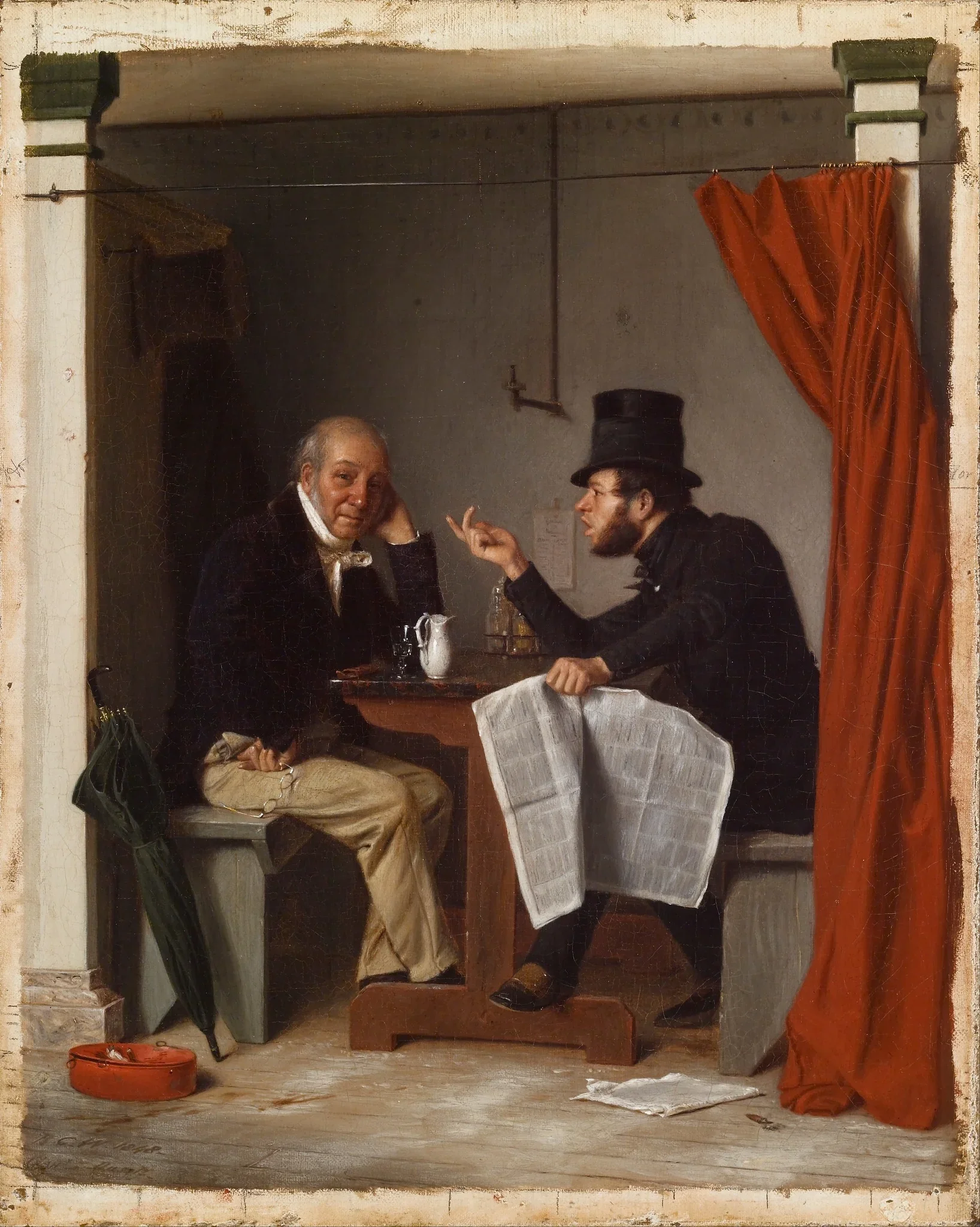
Politics in an Oyster House by Richard Caton Woodville, 1848
Download a pdf of this article
We were about 20 minutes into a conversation at a coffee shop. The atheist on the other side of the table had accepted the invitation to discuss the evidence for the existence of God, but it soon became evident that he was very angry at a God that he said was non-existent. This made no sense to me. On the one hand, he strongly held the belief that there is no God, but on the other hand, how could he be genuinely angry at something that does not exist unless some part of him still believed that God does exist? There appeared to be two contradictory beliefs within him resulting in an agitated emotional/mental state.
Cognitive dissonance can be described as a psychological state of discomfort arising from two or more inconsistent or contradictory beliefs, values, or attitudes, or from evidence that conflicts with them.
When I asked him why he was so angry at a non-existent being, he intensely replied, “Because my mother died of cancer when I was six years old!” Suddenly, his state of cognitive dissonance made a lot more sense. It seemed his grief was standing in the way of belief in God let alone one that claims to be Love, as if he was getting revenge on God by not believing in him.
Our culture today is rife with cognitive dissonance and its symptoms, which creates two problems.
Two Problems
A. How do I productively engage someone who is in such a state?
B. How do I recognize if I am in a state of cognitive dissonance myself?
A. Productive Engagement
In a culture where “my truth” trumps what is actually true, it is essential to have a very clear definition of a true belief. A common-sense definition of a true belief is described by the correspondence theory of truth, defined as follows:
A belief is true if, and only if, it corresponds to the way things actually are.
The inevitable damage that a false belief will lead to occurs when that false belief collides with reality, or “the way things actually are”—and there will be a collision at some point in the future.
With this in mind, here are eight suggestions for productively engaging someone who is in a state of cognitive denial.
1. Speak to both the heart and mind
Speaking only to the intellectual mind, when the underlying issue is an emotional or subjective attachment to something, often carries very little weight. The art of ethical, highly effective persuasion must include both reason and a legitimate appeal to the heart or emotions (as opposed to unethical manipulation). The two approaches are almost never equally weighted, depending upon the person experiencing cognitive dissonance and denial. You must determine what kind of person you are engaging with.
Eventually, in my formal debates on the existence of God, I began to appeal to both the mind and the heart. The results can be summed up in a comment one of my atheist opponents (philosopher Dr. Arthur Shafer) made after I presented an argument from my own experience of the presence of God, to a packed, standing-room-only audience of well over 600 students. In his response, he observed, “When Durston presented his (argument to the heart), you could have heard a pin drop in this room!”
It is crucial that we appeal, in a valid rather than manipulative way, to the hearts of those we talk with. For example, many of my social media posts are landscape photos that display the beauty of nature. Some of the most beautiful and awesome sights, smells, and sounds are found in nature, and there often seems to be a feeling of reverence when we experience natural phenomena such as the aurora borealis dancing in the silence of a northern night sky, the call of a loon on a wilderness lake, or the smell of a cedar forest after the rain.
I suggest that the beauty we see in nature is actually the call of God. It is a legitimate appeal to emotion because God has stated that “his invisible attributes, namely, his eternal power and divine nature, have been clearly perceived, ever since the creation of the world, in the things that have been made” (Romans 1:20).
2. Put them at ease
It was not long before I began including a disclaimer within my opening arguments in formal debates. It went something like this …
“I find that most people will believe what they want to believe, regardless of what I say, so just sit back and enjoy the discussion. Hopefully, I might say something you will find interesting.”
I observed that the mood of the audience changed with that disclaimer.
People tend to have pet beliefs that they will desperately hold on to for the sake of their identity or perceived happiness. They can become defensive and shut you out if you directly challenge those deeply held beliefs. It can be much more effective to discuss things in a relaxed atmosphere and in a venue or manner that people find mutually enjoyable.
An example is a highly productive conversation I had some years ago at a pub in Edinburgh with a group of atheist students and professors. Since I was the sole theist present, their “guard” was down, and the conversation became very honest and enjoyable. Surprising and significant gains were made that night in favour of belief in God.
One of them was a very hostile and aggressive professor who had been specially brought in as the ‘hired gun’ to ‘wipe the floor’ with me, as it were. As I responded to his pointed questions, his attitude changed, and he became increasingly appreciative and respectful. In the end, he reached out to sincerely shake my hand and thanked me for an excellent time together as I left to catch the last bus of the evening to my B&B.
On a scale of -10 to +10, I would say he went from a -7 to a +3. As they say, “One step at a time.”
3. Discuss the real issue
Countless hours have been wasted attempting to convince another person to abandon a cherished false belief when, in fact, the false belief is not the real issue. Instead, try to figure out what the underlying reason might be for that false belief and why that belief is so important to the person.
Then begin to discuss, in a relaxed and casual way, that underlying belief or experience that has made the person so resistant to the truth and susceptible to a false personal belief.
4. Learn the art of asking the right questions
Cognitive dissonance can put a person into such a highly defensive or even hostile state that they will not hear anything you say. It can be pointless to talk “at” such a person.
It can be enormously helpful, instead, to ask some well-chosen questions with a sincere and relaxed attitude. This does two things.
First, it may allow you to better understand the person and even perceive what the underlying issue is.
Second, it permits the person to vent their frustrations and anger. As they see that you are listening to and hearing them, their anger and resistance may slowly dissipate to the point where they become interested in what you might have to say.
5. Tease out and dismantle the underlying issue
Since a person is unlikely to abandon the underlying motivation or cause that creates the cognitive dissonance between truth and the false belief they hold, it might be more productive to address that underlying motivation. This is where the art of asking the right questions is highly useful. A couple of examples may be helpful.
I have often conversed with people who have an underlying revulsion towards Christianity, compelling them to insist that Christianity is false while, at the same time, forcing them into a state of denial with regard to any evidence that supports its authenticity.
Giving them more evidence that Christianity is true is often fruitless without finding out why they are so repelled by it. Usually, they will talk about hypocrisy they have witnessed in Christians, sexual abuse by clergy, or other immoral events.
My response is to first agree that these are, indeed, terrible things and then ask the right question in a genuine, inquiring way: “Do you think this is what Jesus taught?”
That one simple question has often dismantled, in a few seconds, their underlying hostility, at least towards what authentic Christianity actually is.
6. It likely does not all depend upon you
It is often the case that you are not going to single-handedly lead a person out of the forest of cognitive dissonance and denial. Instead, it may be the cumulative effect of many different people.
7. Choose your battles
Online fights in the comment sections of social media may not be the best use of your time. Instead, invest your precious time in a more effective arena and method. Meeting people in a nice coffee shop to talk about important things, in my own experience, has proven to be vastly more productive.
8. Divine intervention
When it comes to faith and God, you cannot make people believe. You are just the messenger; leave the consequences in the hands of God.
A coerced or manipulated belief, especially when it comes to God, can result in a false faith that will eventually fail and will not even remotely compare to a genuine and complete trust in God.
B. Examining yourself
People tend to think that the problem lies with the other person; it seldom occurs to them that they themselves might have the same problem. The thought that one might personally be in a state of cognitive dissonance is something that seldom crosses one’s mind, yet one would be a fool to assume that we are untouched by such a thing.
Here are six suggestions for identifying and successfully dealing with personal cognitive dissonance.
1. Ego is your enemy
Nothing blinds a person to their own faulty thinking quite like pride. The alternative is to have the humility to recognize when you are wrong and to acknowledge wise advice when you are given it.
A symptom of pride is becoming offended or defensive when another person questions your opinions or beliefs. ‘Saving face’ at the expense of admitting you were wrong might also be a sign of holding your ego above truth.
Pride can be every bit as addictive as a drug, so ask other people you respect if they see it in you, and carefully consider what they say.
Pride can be so blinding and have such a grip on a person that nothing short of divine intervention will break its hold. Confess your pride to God and ask Him to change you to be the kind of person He created you to be with genuine (not faked) humility.
Start looking for opportunities to admit you were wrong about something. You may find it to be enormously refreshing.
2. Examine your emotional reactions
When you are presented with evidence that challenges dearly held opinions, do you experience an emotional reaction against that evidence?
Understand that there can be evidence for both sides, and an emotional reaction against evidence for an opposing idea does not mean your own belief is false. It might merely be an indication that you are insecure in your own belief because you have not taken the time to examine why it might be true.
On the other hand, if you do hold a false belief, then you should expect a state of psychological discomfort when confronted with the true, opposing belief. Many false beliefs have truth interwoven amidst the lies so remember, try not to justify what you believe on the basis of what is true about that belief, it is the lies wrapped in a veneer of truth that you may need to identify.
3. Double standards
I have often observed that people accept little or no evidence for a false belief they want to cling to while, at the same time, requiring a much higher standard of evidence for a truth that contradicts “their truth.” Do you have two standards?
4. Think about why you believe what you believe
If you are holding fast to a false belief, the falsity of that position may emerge as you realize that your reasons for holding that belief are quite unsound. Conversely, if you have a cherished belief that is actually true, but you are insecure about the intellectual basis for that belief , deeper thought may reveal valid reasons why your belief is true.
Think very carefully about why you hold the beliefs and opinions you do, as opposed to what might actually be true.
You may find your beliefs to be true in the end, or you may find that the weight of truth points to what you did not want to acknowledge.
Discuss your most cherished beliefs with other people you can trust, who may have thought through these things more carefully or from a different perspective than you have.
5. Value criticism from wise people
Ask for, listen to, and value criticism. It is a form of making ourselves accountable to other, wiser people with regard to what we think might be true.
It will either strengthen our grounds for believing that a belief is true or expose its falsity in favour of the truth.
6. Ask God to renew your mind daily
I would be foolishly naïve if I thought I could always recognize cognitive dissonance in my own thinking or believed that my opinions and feelings were not being shaped by my culture and by what might give me a false sense of value and identity.
Consequently, I regard it as essential to ask God daily to renew my mind—that it not become conformed to my culture or warped by my own desires.
I also study and ponder the enormous wisdom from God that I find in the Bible on a daily basis, and it has become one of the highlights of my daily life. I see the Bible as a forge which hammers away faulty thinking and forges my mind toward spiritual truth. The result is a growing experience of cognitive unity.
Closing thought: As you listen to discussions and engage in them yourself, be sensitive to when a person becomes very defensive, or begins to evade the issue, or deviates from their normal sound reasoning, when an opinion, fact, evidence, or belief that competes with what they seem to hold on to, is brought up. Also, be self aware as to when you exhibit these same symptoms. It may be a sign of cognitive dissonance and resolving it might be therapeutic and beneficial. It does not mean the cherished belief is false or true. Rather, it may indicate a discomfort with a competing belief and it may be an opportunity to examine the two competing beliefs and decide which one is true.
If you would like to talk confidentially with an online mentor about discomfort with, or resistence to God, follow this link.


